




Public Health: Sunnu Wer Gi Yaram
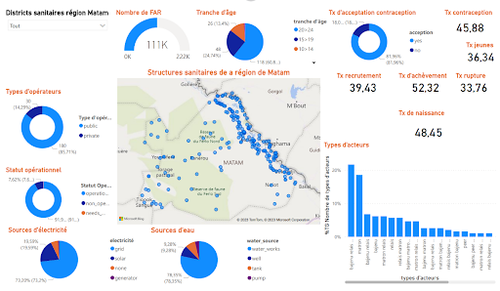
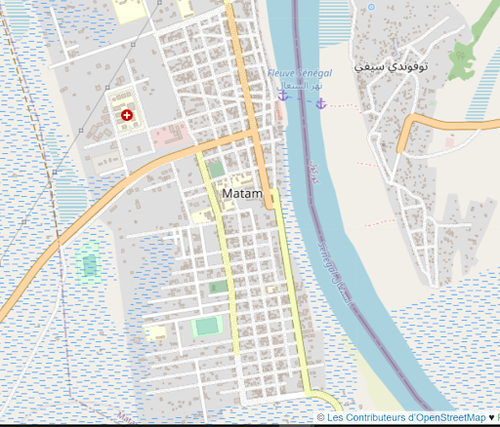
In partnership with Marie Stopes Senegal, the project worked with the Matam regional health authority to map out maternity healthcare services. Healthcare partners in Senegal have been facing challenges in accessing reliable datasets on health facilities, community access, vaccination campaigns, and more. Through its partners, the Sunnu Wer Gi Yaram project provided the necessary data to support Marie Stopes and the Ministry of Health in enhancing their programs and community health services in the Matam region of Senegal.
Objective
During the Ebola Virus Disease and COVID-19 pandemics, healthcare systems were put under immense pressure, particularly in Western Africa. These outbreaks exposed healthcare systems' difficulties in obtaining crucial information on facilities, services, and healthcare practitioners. Pregnant women and young children, in particular, require special attention and often encounter significant obstacles when trying to access healthcare services.
In the region, surveillance, monitoring(recovery, outbreaks), emergency preparedness, disease prevention, research, data and analysis, communication, and health promotion notably need a lot of support due to the lack of resources, adequate information, and technical expertise.
Access to quality healthcare services in Senegal is mainly limited to urban areas, leaving rural populations with inadequate access to primary healthcare. The cost of healthcare is also a factor that affects the sector, as it is expensive to locate health facilities, and there is a scarcity of drugs and personnel and a shortage of specialized doctors. This makes it difficult for low-income earners to access healthcare services due to the high cost of limited treatment.
HOT's Open Mapping Hub in the West and North African region collaborated with Marie Stopes, OSM Senegal, and health authorities in the Matam region to train healthcare providers in collecting data and developing healthcare maps to enhance communities' access to information and services. These maps are helping decision-makers provide adequate healthcare services in rural areas.
The collection of accurate data and mapping of information on the overall healthcare system significantly contribute to decision-making, demand for better service delivery, and care for a highly exposed segment of society, i.e. women.
The project successfully achieved its objectives by adopting an inclusive and participatory approach from the national to the local levels. * Stakeholders were provided training in project methodologies and tools to enhance their capacity. * The project gathered data on health facilities, roads, health hazards, disease outbreaks, and vaccination campaigns, including drug supply, healthcare records, power, staffing, drug dispensation, water access, solid waste management, and more. * Project data is being used to create data products such as datasets and maps that support supply chain management and drug dispensation and ensure that public health facilities services are readily available to all region inhabitants and beyond. * Establish partnerships with key stakeholders to implement practical interventions based on the project's findings and recommendations.
Approach
What methodologies did we use? * Stakeholders mapping, engagements, and Workshops * Remote mapping and field data collection * Data analysis and map product development * Capacity building of technical stakeholders and local community youth
What tools were used: * Tasking Manager - was used for remote mapping activity * Central Server - ODK Central server was used to authenticate store data * JOSM- was used for data cleaning and validation * Quantum GIS - QGIS was used for data analysis and visualization * Open DataKit - was used for field data collection What datasets were collected, etc.
What datasets were collected: Maternity information (drug distribution, patients, doctors, schedules) Health facilities (building, type, power, water, management, solid waste management, etc) infrastructure (clinics, pharmacies, health boxes, health posts, hospitals) Place names Roads and waterways
Based on the data use cases and needs, information related to maternity treatment were collected. These datasets were cleaned, analyzed, and provided to Marie Stopes and the Health Authority of the Matam Region. Only non-identifiable datasets were uploaded to OSM and included in the general maps developed.
Outcome and Impact
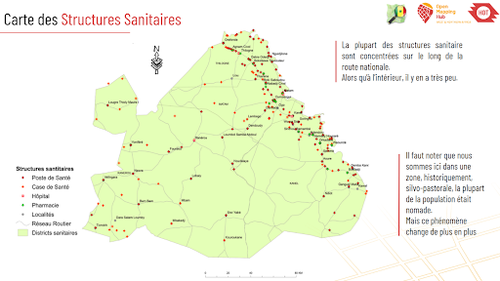
The project contributed: * 93,286 buildings, * 1,803 KM2 of roads * 2 hospitals, * 6 health centers * 104 health posts * 68 health boxes * 2 clinics * 28 pharmacies
Next Steps and Lessons Learned
Marie Stopes and the Regional health authority of Matam are supporting the regional healthcare programs based on the datasets and information provided by the project.
The success of this project was mainly due to Marie Stopes's involvement as a key healthcare provider and the buy-in from the local healthcare authority. Crucial factors for achieving success include planning, executing, and communicating promptly. All stakeholders took on some form of responsibility for the project and supported every aspect of its implementation.
Related News
Migrated News
Setting up the OSM ecosystem in Senegal 3: Reaching out the Senegalese geomatics scene (Senegalese SDI)
With the support of the ICT Directorate and the Agence Informatique de l’Etat (ADIE), HOT and the Canadian Support Project of the Plan National Géomatique (PNG) held a one day workshop around OSM at the ADIE office on June 7th.
Aug. 8, 2012
Migrated News
Setting up the OSM ecosystem in Senegal 6: Building the humanitarian component
It’s finally time to mention the mapping party HOT and OCHA-ROWCA co-organized at the OCHA Office in Dakar the 30-May where we brought together UN IM/GIS from OCHA, World Food Program, UNICEF and ICRC, Karim Sy and Herman Koassy from JokkoLabs and HOT.
Aug. 16, 2012
Migrated News
The OSM Project Senegal: joining Tech Camp Dakar 30-31 August 2012
I am starting a second short trip (28-August – 2-September) to Dakar where HOT has been invited to be part of the TechCamp organized these 30 and 31 August by the US Embassy to facilitate sessions around OpenStreetMap and mapping. We'd like here to thank the organizers for choosing HOT, our friends and partners from JokkoLabs – a co-working space in Dakar - who recommended HOT to the be part of the Camp, and finally, the Fondation de France and the Association OpenStreetMap France (OSM-FR) for their continued support. All made this second trip to Senegal possible.
Aug. 28, 2012
Migrated News
Animating the OSM Senegal Community
In Dakar, back from Saint-Louis where I have been mostly working animating the OSM SN community in this town harnessing on our partnerships with BantaLabs and University Gaston Berger and reaching out to new partners from NGOs and Governements. Prior getting into details about those intense and rich days for the OSM Project Senegal and its community, I'd like to take a look back at the past weeks since the end of the HOT set up mission of this program by Mid December.
At BarCamp Thies
I spent a week in Dakar preparing with some active mappers of the OSM SN community the attendance of the Thies BarCamp organized by the Senegalese OpenSource movement.Jan. 15, 2013